
ClioSport.net
-
When you purchase through links on our site, we may earn an affiliate commission. Read more here.
You are using an out of date browser. It may not display this or other websites correctly.
You should upgrade or use an alternative browser.
You should upgrade or use an alternative browser.
Acoustic Valve... The Truth
- Thread starter powello9
- Start date

The 'acoustic valve' closes to help warm the engine up quicker on cold days. By closing the main air-feed it forces the engine to draw in the warmer 'engine bay' air from the second feed. It also helps reduce drive by noise levels.
It does not IMHO have anything to do with increasing low down torque or help in anyway with general peformance.
It does not IMHO have anything to do with increasing low down torque or help in anyway with general peformance.

BenR said:but both airbox feeds go to the front bumper area.......no hot air there.
While I agree that the the 2nd air feed does not point towards the engine, it also does not feed down behind the bumper where the air is bound to be cooler?
In your professional opinion what does the valve do then and why was there never one fitted to the mki 172?
at the front of the car, when you start up, there will be zero difference between those areas temp wise.
Any by the time there is any mild temp diff when sitting stationary, the engine will be fully warm......and when your moving, well, again no diff.
I've never seen it working to any effect and tbh i'm not too interested in it.
Any by the time there is any mild temp diff when sitting stationary, the engine will be fully warm......and when your moving, well, again no diff.
I've never seen it working to any effect and tbh i'm not too interested in it.

7MAT said:OK I see what you are saying - but being an engine builder you must have a theory at least for why Renault added the valve in the first place?
There are plenty of theories about, but like i've said i've never 'seen' one work.
There is no documentation, and none of the theories about really have any concrete base.


wrx-172 said:Got to be there for a reason... If it doesnt do anything why bin it?
its gets in the way, and in my opinion i see it as a restriction, bin it, all the quick clios don't have it


Clio 172 mk2
7MAT said:While I agree that the the 2nd air feed does not point towards the engine, it also does not feed down behind the bumper where the air is bound to be cooler?
In your professional opinion what does the valve do then and why was there never one fitted to the mki 172?
Nothing to do with air temp.
It's basically a device to alter the length of the inlets at different engine speeds to increase torque hence the two ducts.
If people want to cut pipes off and install air feeds to foglights etc and get the placebo effect of noise etc that's up to them....Renault took time designing the air intake system on the 172/182 to work well...I just don't see the point of messing about with it.
Neil G said:Nothing to do with air temp.
It's basically a device to alter the length of the inlets at different engine speeds to increase torque hence the two ducts.
If people want to cut pipes off and install air feeds to foglights etc and get the placebo effect of noise etc that's up to them....Renault took time designing the air intake system on the 172/182 to work well...I just don't see the point of messing about with it.
How do you know this? As BenR has said above its not been documented?
I believe Renault did it because like all manufacturers they have to make compromises to meet emision targets etc.
Don't remove it. It improves low to mid range torque. Renault's engineers wouldn't have added the cost of it to the car if it didn't do anything.
What happens is that you get the best power at the top end if air can flow into the airbox with the least restriction. Ie, you want big air intake pipes. But if you have big intakes pipes at lower speeds when there's less air needed you get low air speeds. And when you factor in the pressure pulses that bounce back and forth in the intake system as the vales open and close you get flow reversals. The speeds up, stops, goes backwards, stops, goes forwards again. That produces less airflow that a smaller pipe that has a fast enough air speed in it that the pulses don't reverse the air flow. So what Renault engineers did was to have to pipes, both open at high speed for the least restriction, and one closed at low speeds for better torque.
Also if you open up that other pipe at lower speeds you get more noise. When they're on full throttle you don't mind noise. But when you're sitting on the motorway at lower revs and part throttle most grownups find intake drone tiresome. Closing the big pipe cuts the noise in those conditions.
The car will sound faster by making more noise if you remove the acoustic valve or lock it open. But it will actually be slower.
What happens is that you get the best power at the top end if air can flow into the airbox with the least restriction. Ie, you want big air intake pipes. But if you have big intakes pipes at lower speeds when there's less air needed you get low air speeds. And when you factor in the pressure pulses that bounce back and forth in the intake system as the vales open and close you get flow reversals. The speeds up, stops, goes backwards, stops, goes forwards again. That produces less airflow that a smaller pipe that has a fast enough air speed in it that the pulses don't reverse the air flow. So what Renault engineers did was to have to pipes, both open at high speed for the least restriction, and one closed at low speeds for better torque.
Also if you open up that other pipe at lower speeds you get more noise. When they're on full throttle you don't mind noise. But when you're sitting on the motorway at lower revs and part throttle most grownups find intake drone tiresome. Closing the big pipe cuts the noise in those conditions.
The car will sound faster by making more noise if you remove the acoustic valve or lock it open. But it will actually be slower.
R
rich[182]
If this simple device is so useful then why don't you find one on all cars, I mean theres prob less than a tenners worth of metal there ?
Even with the valve fully open, if you look down the opening the already small diameter of less than 50mm is obstructed by the valve so you cant possibly get smooth unrestricted airflow, also the flexible pipe connecting the valve to the airbox is utter s***e, its a non smooth inner wall and kinks in the middle, I wouldn't use this intake on my frickin' petrol lawnmower, maybe not the valve but the actual pipe is getting replaced soon as
Even with the valve fully open, if you look down the opening the already small diameter of less than 50mm is obstructed by the valve so you cant possibly get smooth unrestricted airflow, also the flexible pipe connecting the valve to the airbox is utter s***e, its a non smooth inner wall and kinks in the middle, I wouldn't use this intake on my frickin' petrol lawnmower, maybe not the valve but the actual pipe is getting replaced soon as

182 Full Fat
haitch said:binned mine this weekend, still very tight to get a 70mm caf in its place i thought.
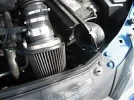
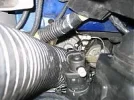
You can just squeeze an 85mm air feed down where the acoustic valve used to be, see my pics:
Attachments
Clio 172 mk2
GordonD said:Don't remove it. It improves low to mid range torque. Renault's engineers wouldn't have added the cost of it to the car if it didn't do anything.
What happens is that you get the best power at the top end if air can flow into the airbox with the least restriction. Ie, you want big air intake pipes. But if you have big intakes pipes at lower speeds when there's less air needed you get low air speeds. And when you factor in the pressure pulses that bounce back and forth in the intake system as the vales open and close you get flow reversals. The speeds up, stops, goes backwards, stops, goes forwards again. That produces less airflow that a smaller pipe that has a fast enough air speed in it that the pulses don't reverse the air flow. So what Renault engineers did was to have to pipes, both open at high speed for the least restriction, and one closed at low speeds for better torque.
Also if you open up that other pipe at lower speeds you get more noise. When they're on full throttle you don't mind noise. But when you're sitting on the motorway at lower revs and part throttle most grownups find intake drone tiresome. Closing the big pipe cuts the noise in those conditions.
The car will sound faster by making more noise if you remove the acoustic valve or lock it open. But it will actually be slower.
Totally agree
Bunging on large diameter intake pipes because they are 'unrestrictive' is bollox.
Try putting a 5 inch bore exhaust on the Clio and see how it affects performance......the same principles apply.
Clio 172 mk2
FredYozzasport said:anyway if you are a man and want a quick clio bin it!
So if I remove it I'll get massive amounts of boost?

TBH I'm worried about removing it incase I break a fingernail lol
GordonD said:Don't remove it. It improves low to mid range torque. Renault's engineers wouldn't have added the cost of it to the car if it didn't do anything.
What happens is that you get the best power at the top end if air can flow into the airbox with the least restriction. Ie, you want big air intake pipes. But if you have big intakes pipes at lower speeds when there's less air needed you get low air speeds. And when you factor in the pressure pulses that bounce back and forth in the intake system as the vales open and close you get flow reversals. The speeds up, stops, goes backwards, stops, goes forwards again. That produces less airflow that a smaller pipe that has a fast enough air speed in it that the pulses don't reverse the air flow. So what Renault engineers did was to have to pipes, both open at high speed for the least restriction, and one closed at low speeds for better torque.
Also if you open up that other pipe at lower speeds you get more noise. When they're on full throttle you don't mind noise. But when you're sitting on the motorway at lower revs and part throttle most grownups find intake drone tiresome. Closing the big pipe cuts the noise in those conditions.
The car will sound faster by making more noise if you remove the acoustic valve or lock it open. But it will actually be slower.
That is one theory, but again it is flawed.
The basic of variable length inlet system is nice, and the use of a smaller intake diameter at slow rpm is also nice. BUT, they cannot occur in the manner you speak sadly.
1) The issue with intake velocity is that the valve is upstream of the air filter. This air filter will destroy andy difference in velocity upstream from it, i.e. the filter laminitaes the flow as it passes through it. An engine consuming 1000ltrs of air a second constant will lead to differing velocities through one 50mm pipe or 2. BUT, when that velocity meets the airfilter it has to pass through it at the same rate as 2 supply ducts would, its laminated (laminar flow generated) and enters a constant volume intake system where velocity will not change irrespective of what you do pre air filter. Velocity changes only really take effect post throttle body, mainly the intake runners, ports and valve bowls/seats.
2) the notion of changed the tuned lenths is also flawed for the same reason. The paper type air filter does not allow accurate and constant passing of intake pulses, especially as they change all the time passing through a plenum, depending on throttle angle and RPM. If renault were actually concered with such phenomenons in a greater manner than the fixed induction system, they would be running a helmholtz resonator or similar.
So that is why i say none of the theories present me as true.

R35 GTR
FredYozzasport said:4) its sh*t, bin it
This is fact! I read it in the owners manual.
oooops, it was referring to the car.

Similar threads


- Replies
- 5
- Views
- 238


- Replies
- 2
- Views
- 388
- Replies
- 5
- Views
- 846
