
ClioSport.net
-
When you purchase through links on our site, we may earn an affiliate commission. Read more here.
You are using an out of date browser. It may not display this or other websites correctly.
You should upgrade or use an alternative browser.
You should upgrade or use an alternative browser.
Really feint hesitation/miss at light throttle
- Thread starter jinjur
- Start date

Touring_Rob
ClioSport Club Member
Looking at the logs it seems that your throttle and MAP are working fine. They react together.
A slow return to idle (if the throttle plate is closed as your log suggests) indicates an air leak to me.
Can you measure the time delay between opening throttle and the RPM increasing?
Can you log throttle plate position against TPS%?
Does the software give an estimated AFR/Lambda value?
I tend to log RPM, MAP, TPS, Ignition advance and AFR exclusively when trying to diagnose things like this. Once you have eliminated things like coolant and MAT.
Also useful to compare peak vacuum on over run with other known good cars.
A slow return to idle (if the throttle plate is closed as your log suggests) indicates an air leak to me.
Can you measure the time delay between opening throttle and the RPM increasing?
Can you log throttle plate position against TPS%?
Does the software give an estimated AFR/Lambda value?
I tend to log RPM, MAP, TPS, Ignition advance and AFR exclusively when trying to diagnose things like this. Once you have eliminated things like coolant and MAT.
Also useful to compare peak vacuum on over run with other known good cars.
From what i see in your erors there is a problem with the throtle body,, like other say check the connection on throtle and on injection computer, and the wires
I most cases the throtle is bad , change it with one that you are sure that it's working properlly. You can use any throtle from clio 172 182 197 or twingo 133 , they are the same.
Make a graph at idle to TPS and look if the both tracks are staying constantly, if they aren't change the throthe body.
I most cases the throtle is bad , change it with one that you are sure that it's working properlly. You can use any throtle from clio 172 182 197 or twingo 133 , they are the same.
Make a graph at idle to TPS and look if the both tracks are staying constantly, if they aren't change the throthe body.

2003 Clio 172
Thanks for the responses guys, apologies for the delays.
Driving the car now a few weeks since the main issues were seemingly sorted and you know what, i still feel hesitation and holding back at low rpm and light pedal situations
Car will kangaroo like a lunatic in stop start traffic, say in 1st or 2nd gear..........even if i back off the accelerator
Now, plug leads were not done, not sure if I was clear on that before. I know they are only 50 quid and again, a consumable IMO so may throw a set at it anyway but not sure if that is relevant.
Can't be many sensors / components now that could attribute to this behaviour :/
With regards to the idle, its not necessarily low or slow, it is just that when it drops, IT DROPS. Almost too fast for it to catch.
And i might be super paranoid here........but i am almost sure it is running rich.
A spirited blurt on the motorway with headlights behind me and for the first time i have had the car, I saw smoke when it got into the higher rpm band. I have never seen this in the past and I do look for it, car never uses enough oil to warrant top ups between service. Perhaps it drops one nick on the dash and never smells of burning oil. ever.
J
Driving the car now a few weeks since the main issues were seemingly sorted and you know what, i still feel hesitation and holding back at low rpm and light pedal situations
Car will kangaroo like a lunatic in stop start traffic, say in 1st or 2nd gear..........even if i back off the accelerator
Now, plug leads were not done, not sure if I was clear on that before. I know they are only 50 quid and again, a consumable IMO so may throw a set at it anyway but not sure if that is relevant.
Can't be many sensors / components now that could attribute to this behaviour :/
With regards to the idle, its not necessarily low or slow, it is just that when it drops, IT DROPS. Almost too fast for it to catch.
And i might be super paranoid here........but i am almost sure it is running rich.
A spirited blurt on the motorway with headlights behind me and for the first time i have had the car, I saw smoke when it got into the higher rpm band. I have never seen this in the past and I do look for it, car never uses enough oil to warrant top ups between service. Perhaps it drops one nick on the dash and never smells of burning oil. ever.
J
Touring_Rob
ClioSport Club Member
Whats the coolant and air temperature being reported as? Not sure I've seen them on any of your logs.
Touring_Rob
ClioSport Club Member
Will have to get another data run Rob which has been scuppered tonight as one of the littl'uns is sick bless her.
Will do asap
J
No worries dude, sick children (especially little ones) is the worst thing in the world - mine has just gotten over the dreaded pox which arrived just in time for Xmas. Hope she feels better by tomorrow.
2003 Clio 172
No worries dude, sick children (especially little ones) is the worst thing in the world - mine has just gotten over the dreaded pox which arrived just in time for Xmas. Hope she feels better by tomorrow.
Cheers bud, this wee one is just boking so not a patch on the pox but still.....sucks
J
2003 Clio 172
Still haven't managed to grab any logs yet, sorry about that.
Total fart this morning though as I approached the end of my street.
Went to pull out from the end of the junction, car running fine....cold and lumpy but usual. Pushed the pedal to go and......................nothing. Didn't stall......just sat idling. Did it again, same. Shouted a bit *normal bad words*, tried again and away it went...............business as usual.
No EML. Nothing.
Then...........after about an hours sitting in traffic, arrived at work and the EML came on reporting P0136.
Kill
Me
Total fart this morning though as I approached the end of my street.
Went to pull out from the end of the junction, car running fine....cold and lumpy but usual. Pushed the pedal to go and......................nothing. Didn't stall......just sat idling. Did it again, same. Shouted a bit *normal bad words*, tried again and away it went...............business as usual.
No EML. Nothing.
Then...........after about an hours sitting in traffic, arrived at work and the EML came on reporting P0136.
Kill
Me

JamesBryan
ClioSport Club Member
P0136
Is that a post cat O2 sensor fault?
Is that a post cat O2 sensor fault?
2003 Clio 172
It is bud............while sitting in traffic i threw on my "worlds cheapest piece of turd bluetooth OBD reader" from the glovebox............it does server a purpose sometimes 
that is where i got the error code from
popped up both O2 outputs in torque (the traffic was BAD) and the rear O2 sensor value was all over the place
I was under the impression that this one was generally a static yes/no kind of affair :/
J
that is where i got the error code from
popped up both O2 outputs in torque (the traffic was BAD) and the rear O2 sensor value was all over the place
I was under the impression that this one was generally a static yes/no kind of affair :/
J
JamesBryan
ClioSport Club Member
Rear O2 sensor won't affect the running of the car anyway, it's just for emissions.
2003 Clio 172
Yep. That is what I thought. I have a few other O2's at home so will swing one in tonight and see if it changes the light
Other observation is that this thing is banging out of the exhaust........and it never did. Not "pops and bangs" banging but say letting it run down in 2nd or 3rd from high revs when warm will result in a serious *THWAP* from the exhaust every now and then.
Could this be the new injectors doing a better job of getting fuel in or could it be running rich?
Or, are your cars doing the same thing?
J
Other observation is that this thing is banging out of the exhaust........and it never did. Not "pops and bangs" banging but say letting it run down in 2nd or 3rd from high revs when warm will result in a serious *THWAP* from the exhaust every now and then.
Could this be the new injectors doing a better job of getting fuel in or could it be running rich?
Or, are your cars doing the same thing?
J
JamesBryan
ClioSport Club Member
Could be running rich.
Mine rarely pops, but it does occasionally on the downshift.
Mine rarely pops, but it does occasionally on the downshift.
Touring_Rob
ClioSport Club Member
My front lambda failed, the car would throw post cat faults for a while before it reported the front.
While there was no EML the car would do exactly (well, nearly exactly, mine would missfire a bit too) what you describe above.
While there was no EML the car would do exactly (well, nearly exactly, mine would missfire a bit too) what you describe above.
Touring_Rob
ClioSport Club Member
I'm not 100% blaming the front lambda, but certainly give it a test. As said above the read lambda will have no impact on how the car runs its just there to see if the cat is working.
You could always have another sensor fault such as a coolant sensor problem which would/could make the car run rich or lean. I would expect this to be reported as a fault but if the value being reported by the sensor is plausible a fault state will not be triggered.
You could always have another sensor fault such as a coolant sensor problem which would/could make the car run rich or lean. I would expect this to be reported as a fault but if the value being reported by the sensor is plausible a fault state will not be triggered.

PH2 172
As said above the read lambda will have no impact on how the car runs its just there to see if the cat is working.
.
Is this actually true though?
https://mechanics.stackexchange.com...oxygen-sensor-used-for-engine-mixture-control

PH2 172
Very interesting post Steve..............
Just seems odd that this is the first time I have ever noticed the value of the rear O2 changing when I was driving it. It was always a static value.
J
On another recent CS thread, the OP had problems because a pin or pins had been pushed out the loom plug for the Lambda.
As you have just changed yours. it`s worth checking.
Touring_Rob
ClioSport Club Member
Is this actually true though?
https://mechanics.stackexchange.com...oxygen-sensor-used-for-engine-mixture-control
Impossible to say without knowing how the Renault ecu uses the data. I'm just going by what others have said on here and also given that many people code out/disable the post cat lambda without any running issues.
It would be understandable for Renault to adjust fueling to achieve best post cat emissions however I would strongly suggest that it is the pre cat lambda which will have the biggest influence over immediate/short term fuel trims and probably have the larger allowable trim tolerance.
In my own personal experience, my primary cat lambda failed (totally open circuit, sensor rattling lots) the car would not immediately flag an EML and the EML reset with ignition on/off. With a cold engine 30s-2mins after start the car would bog down terribly, missfire a little and do nothing, Felt exactly as if the throttle had been closed.
I can only guess that this was the ecu trying to apply wrong trim values to the fuel table based on totally incorrect data from the primary lambda sensor. After a few moments the engine would return to normal as the new 'corrections' were ignored. In this instance I do not think the post cat lambda (which was working fine) had any influence over the fuel table, it may have been used to detect the non plausible values given by the primary lambda though. However my stored codes also included a misfire which again can be detected using various methods.
This fits with other cars which I have owned and also the settings which I have used for closed loop fueling in after-market ecus. The lambda values are nearly always ignored until a preset coolant temperature, hence my car starting as normal and taking a little time to bog down.
Its an interesting subject, the answer would I'm sure help lots of people and comes down to what Renault are doing with the data from the post cat lambda, ie using it for fuel correction or just using it as a cat health check.
Last edited:
2003 Clio 172
Interesting points Rob. In my head it has always been a binary switch on these cars..........well.............every time i have been looking at the logs (which has been a-lot lately to be fair) it has always sat between 4/500.
That is why i was surprised to see it doing a roller coaster this morning.
That is why i was surprised to see it doing a roller coaster this morning.
PH2 172
@Touring_Rob
It may well be the case that the Ph2 Clio`s are old too use the rear lambda for anything other than checking the cat, but it would good to know for sure.
Something to be borne in mind when dealing with newer vehicles though.
It may well be the case that the Ph2 Clio`s are old too use the rear lambda for anything other than checking the cat, but it would good to know for sure.
Something to be borne in mind when dealing with newer vehicles though.
JamesBryan
ClioSport Club Member
With the late 90's tech of these i can't see them using dual sensor lambda control for fueling.
I'd bet the 197/200's do though.
I'd bet the 197/200's do though.
Touring_Rob
ClioSport Club Member
Going to data log the whole journey home but sods law....................it will be absolutely perfect
Things like this make you wish you were logging all of the time ffs
Will be interesting to know what you discover!
Touring_Rob
ClioSport Club Member
@Touring_Rob
It may well be the case that the Ph2 Clio`s are old too use the rear lambda for anything other than checking the cat, but it would good to know for sure.
Something to be borne in mind when dealing with newer vehicles though.
Supposedly my E46 uses both and that is a similar era to the clio design wise. The Clio could be using the post lambda for slower feedback. Could probably rule it out by doing an adaption reset if thats possible?
I occasionally reset all the adaptations on my bmw using thier INPA stuff and it runs much better for a few hundred miles.
JamesBryan
ClioSport Club Member
You can reset the adaptations with Clip.
2003 Clio 172
ok, so here is the plot once the car was warm and I was driving
blue is front o2, oscillating as expected
orange is rear o2, fairly static in and around 0.4 (not sure what scale that is but same scale as blue)
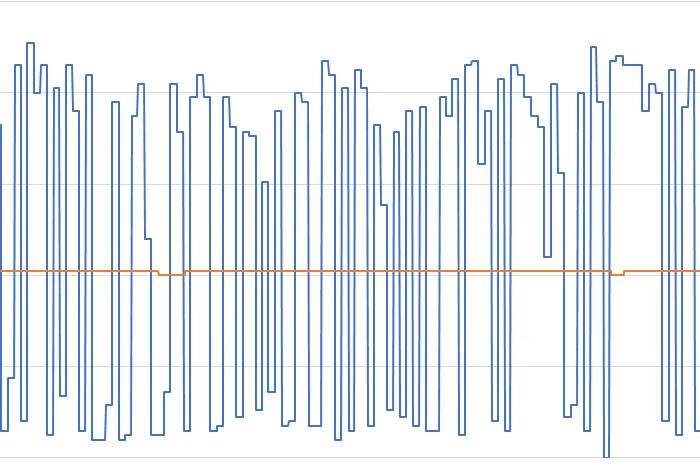
here is the plot towards the end of the journey
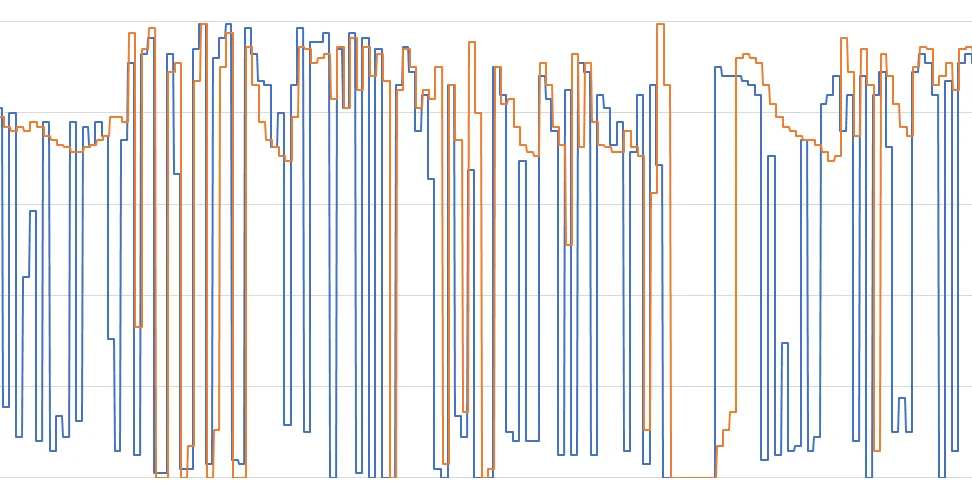
No EML light on way home mind you but just reaching out to see if that is normal?
If this is treated as a binary switch to say "yes, the cat is working" then surely this is saying "yes it is, oh, no it isnt, yes it is, oh, no it isnt, yes it is, oh, no it isnt, yes it is, oh, no it isnt..............." etc etc
?
J
blue is front o2, oscillating as expected
orange is rear o2, fairly static in and around 0.4 (not sure what scale that is but same scale as blue)
here is the plot towards the end of the journey
No EML light on way home mind you but just reaching out to see if that is normal?
If this is treated as a binary switch to say "yes, the cat is working" then surely this is saying "yes it is, oh, no it isnt, yes it is, oh, no it isnt, yes it is, oh, no it isnt, yes it is, oh, no it isnt..............." etc etc
?
J

Coops Mk1
ClioSport Club Member
Lots of Scrap...
This thread has been a year right? I've read first two and last one with data logging and thinking for a cut out issue this is crazy amounts of diagnosis over a long time. Has anyone suggested actual fuel quality issues? Apologies if mentioned already, but one of my old 172's (phase 1 admittedly not fly by wire etc, but same basic configuration) used to hate cheap fuel, had to run it on super no matter what or it used to splutter, cut out, die and do all sorts of other horrible things. Soon as I upped the Ron in the fuel, was fine.
Again apologies if already covered but I'm too lazy to read 8 pages and year of issues
Again apologies if already covered but I'm too lazy to read 8 pages and year of issues
2003 Clio 172
To be fair, the thread has basically covered everything wrong with the car and I do hope it might be of use for some.
You know...........we have hit timing, map readings, replacement of LOTS of stuff now we are doing logging etc
Also to me...............its kind of a big deal that I replaced injectors and it had little or no effect seeing as those alone are seen as the holy grail in these older little monkeys
So i think the thread is of worth albeit rambling on.
In terms of fuel, we are limited in Northern Ireland. We don't get any of the real fancy stuff as apparently it doesn't travel. Best we have is your supers and to that effect I always use Texaco............always have done as I rate it and the wee car always (used) to run grand on it.
I did try 3-4 tank fulls of BP Ultimate to see if that was an issue but no change
J
You know...........we have hit timing, map readings, replacement of LOTS of stuff now we are doing logging etc
Also to me...............its kind of a big deal that I replaced injectors and it had little or no effect seeing as those alone are seen as the holy grail in these older little monkeys
So i think the thread is of worth albeit rambling on.
In terms of fuel, we are limited in Northern Ireland. We don't get any of the real fancy stuff as apparently it doesn't travel. Best we have is your supers and to that effect I always use Texaco............always have done as I rate it and the wee car always (used) to run grand on it.
I did try 3-4 tank fulls of BP Ultimate to see if that was an issue but no change
J

Ph2 172, 106 Rallye
https://www.merlinmotorsport.co.uk/p/millers-cvl-turbo-octane-booster-mill-turbo
Worth a shot? My rallye failed MOT on emissions (It had sat for a year and only covered 70 miles) but after I fired a bottle of that in the tank and gave it an italian tune-up, it passed with flying colours.
Worth a shot? My rallye failed MOT on emissions (It had sat for a year and only covered 70 miles) but after I fired a bottle of that in the tank and gave it an italian tune-up, it passed with flying colours.
Similar threads
- Replies
- 3
- Views
- 1K
- Replies
- 34
- Views
- 923

- Replies
- 2
- Views
- 2K

- Replies
- 2
- Views
- 1K

